

On paper, the scope of a core insurance suite looks settled: underwrite, administer policies, pay claims. In practice, replacement projects almost never derail on those three blocks. They derail on what nobody wrote into the initial scope.
Billing treated as a side topic, delegated authority bordereaux rebuilt in Excel, distribution network management left out: those blind spots cost more than the choice of vendor itself.
This article walks through the full scope of a core insurance suite, chain by chain, then through the domains that are systematically underestimated at scoping time.
When the core insurance suite question really comes up
Nobody wakes up one morning deciding to replace their system. The thinking starts when several signals pile up and begin to weigh on the commercial side of the business.
- Getting a product to market takes several months, while the commercial window closes in a few weeks.
- A simple coverage or pricing adjustment goes through custom development and a full test cycle.
- Teams re-key the same information into two or three tools, with the data discrepancies that follow.
- Consolidation is done by hand at month end, which makes business reporting approximate at best.
- Every regulatory change is handled as a project, on timelines that owe more to luck than to process.
- The distribution network works around the extranet because the interface slows the sale down instead of speeding it up.
One or two of these can be fixed with an extra tool. When four or five pile up at once, the issue is no longer the tool: it is the scope the system itself covers.
What a core insurance suite covers across the whole chain
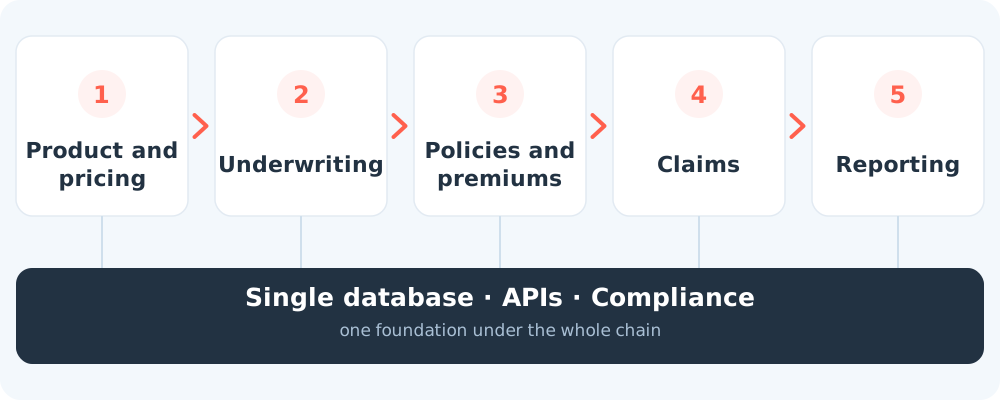
What separates a core insurance suite from an assembly of software packages is a simple principle. Data is captured once, then flows from one business domain to the next without re-keying. That principle is what every gain vendors advertise actually rests on.
Product design and pricing
It all starts with configuration: coverages, exclusions, underwriting rules, rating tables. A modern suite makes those elements configurable by business teams, without a development request every time.
This is the first lever on time to market, in P&C as much as in life and health, where medical and protection products combine more complex premium grids.
Underwriting and sales
The underwriting journey covers risk capture, quote generation, e-signature and hand-off into policy administration. For a wholesale broker, the extranet made available to the network is an integral part of that scope: it is where the conversion rate on new business is won or lost.
How smooth that journey is directly determines the volume of business the sales teams can handle.
Policy and premium administration
This is the historic core of a core insurance suite. It holds the policy lifecycle, endorsements, portfolio movements, premium calls, collection and cancellations.
Policy administration is also where a solution’s real flexibility shows: a complex endorsement handled in minutes or over several days is not the same job.
Claims management
Claims management covers first notice of loss, file opening, handling workflows, loss adjuster and supplier follow-up, then settlement. Recent solutions add fraud detection and automatic analysis of incoming documents.
This is the domain where automated processing produces the most visible gains, both on turnaround times and on handler workload.
Customer relationship and business reporting
A complete core insurance suite includes an online space for policyholders, a unified interaction history and dashboards fed in real time. Without that layer, the customer relationship stays dependent on the phone and email, and reporting stays a spreadsheet affair.
The domains forgotten at scoping
Here is the part that requirement documents cover in one line, and that then takes up half the project.
Billing and technical accounting
Issuing premium notices is one thing. Reconciling collections, managing arrears, allocating commissions, producing the entries and accounting flows of technical accounting, then passing them on to the risk carrier, is another.
That chain is precisely where the operational reliability of a portfolio is decided. Many products on the market stop at issuance. Payment reconciliation, arrears follow-up, calculating what has to be passed back and producing accounting flows then end up as manual work, with a discrepancy risk that grows as the portfolio grows.
Bordereaux and delegated authority reporting
As soon as business is delegated, producing bordereaux becomes both a contractual obligation and a control exercise. Every risk carrier has its own format, frequency and rules.
A suite able to generate those statements straight from administration data, with no rework, removes an entire desk. Korint produces bordereaux and reporting from administration data: written and collected premiums, taxes, commissions, refunds, arrears, payment statuses and amounts to be passed back. Those statements can be adapted to the risk carrier’s requirements and delivered by API, configurable files or SFTP.
Distribution network management
Authorisations, agreements, commission schemes, production tracking per introducer, sales campaigns: network management is a business domain in its own right, and rarely part of a demo.
Yet it is what lets you run a broad distribution base and know, in real time, which introducer is writing what.
Regulatory control and compliance
Compliance is not a box to tick. It assumes controls embedded in the processes: AML/CFT checks at underwriting, action traceability, retained evidence of the duty of advice, retention-period management.
Compliance handled outside the system becomes a permanent load on the teams. Compliance built in becomes an automatic check.
Archiving and data reversibility
The last blind spot, and the most expensive: the ability to get your data back. Export format, completeness, documentation of the data model, exit conditions. These are negotiated before signature, never after.
The scope of a core insurance suite in one table
| Domain | What the suite has to cover | The question to ask the vendor |
|---|---|---|
| Products and pricing | Coverages, business rules, rating tables, overrides | How simply can a rate be changed? |
| Underwriting and distribution | Quotes, forms, signature, network extranet | How long until a new product is distributed? |
| Policies and premiums | Lifecycle, endorsements, premium calls, collection | Can a complex endorsement be handled without technical work? |
| Claims | FNOL, workflows, loss adjusting, settlement, fraud | Are the workflows configurable? |
| Billing and accounting | Reconciliation, arrears, commissions, entries | Are accounting entries generated natively? |
| Bordereaux and delegation | Statements per risk carrier, formats, frequencies | Do bordereaux come out without manual rework? |
| Distribution network | Authorisations, agreements, commissions, production | Can production per introducer be tracked in real time? |
| Compliance | AML/CFT, duty of advice, traceability, retention | Are the controls embedded in the processes? |
| Data and security | Hosting, encryption, access, reversibility | Which certifications can the vendor show? |
This table can be lifted straight into a requirements document. Every line left unanswered during scoping becomes a negotiation point after signature.
Data security: the foundation of a core insurance suite
Insurance data is among the most sensitive there is. Security therefore belongs to the functional scope, not to the technical appendices.
Three topics deserve the same scrutiny as the business requirements:
- The technical foundation: encryption at rest and in transit, hosting in Europe, continuity plan, contractual service availability.
- Access control: fine-grained profiles per team and per perimeter, strong authentication, full traceability of reads and changes.
- Controlled openness: a suite open by API exchanges with your partners, your internal tools and the market’s data services, provided those exchanges are authenticated, logged and continuously monitored.
Data security and openness are not opposites. It is the absence of a documented API that produces the workarounds, the unofficial exports and the files circulating outside the system.
Full suite or modules: how to decide
Three models coexist on the market. The all-in-one legacy system, solid but slow to evolve. The assembly of specialist solutions, flexible on the surface, but whose real cost is paid in data reconciliation and broken processes. And the modular suite, which lets you switch on one domain at a time on a single data foundation.
The decision comes down to four criteria, in this order:
- A single version of the data across underwriting, policies and claims.
- The ability to switch on a new domain without rebuilding what exists.
- API openness towards the rest of the information system.
- The pace at which the vendor ships improvements.
A player that needs to move fast on a specific perimeter is better off starting with a module — bonus points if that module belongs to a complete suite.
How to evaluate a core insurance suite
When comparing offers, a handful of questions separate the credible solutions from the rest:
- Which configuration can business teams do on their own, and which requires the vendor?
- How long between the decision to launch a product and its first actual sale?
- Are bordereaux, billing and commission management native or optional?
- Which AI capabilities are genuinely in production at client sites, and on which processes?
- How does data migration work, and on what timeline?
These questions belong upstream, during scoping. Asked later, they turn into change requests.
Korint, a modular core insurance suite
Korint is an AI-native insurance platform built for wholesale brokers, MGAs and insurers. It covers product design, pricing, underwriting, portfolio administration, claims management and reporting, with AI agents built into the core of the system rather than bolted alongside it.
One foundation that adapts to your starting point
Each domain works as a standalone module or within the complete suite, on a shared database and an API-first approach. So Korint starts from wherever you are: replacing an ageing back office, or adding a block where the current system stops.
Integration with the rest of the information system goes through documented APIs, and the Marketplace gives access to around fifty native connections, from payment to e-signature.
What the suite covers
- Core: portfolio administration, policies, servicing transactions, billing, reporting and accounting.
- Reach: distribution, underwriting journeys and the network extranet, built around the customer experience.
- Engine: no-code product creation, business rules, rating tables, automatically generated API documentation.
- Claims: FNOL, workflows configurable per file type, fraud detection, settlement.
- AI agents: reading incoming documents, updating policies, chasing follow-ups, under human control.
What it changes day to day
Automating repetitive transactions gives time back to handlers, and configuration without development makes a product launch far quicker. With Korint, a simple offer takes weeks to launch, where a conventional project elsewhere is counted in quarters.
The effects measured at our clients point the same way, with productivity up 48% after twelve months and active portfolios growing 52%. That efficiency owes less to any one spectacular feature than to the quality of the foundation: one application for the teams, one database for the data. On security, Korint is ISO 27001 and SOC 2 Type II certified, GDPR compliant and hosted in Europe.
Preparing a replacement project and want to test your scope against what Korint actually covers? Get in touch — we will go through it with your teams.