
Embedded insurance means offering cover at the exact moment a customer buys a product or a service, directly inside a third-party brand’s sales journey. For wholesale brokers, delegated-authority brokers and insurers, it is a digital distribution channel in its own right, with its own technical flows, rules and tools. This guide walks through each step, from the first data exchange to choosing the platform that will carry your business.
Embedded insurance in brief
The principle fits in one sentence: insurance is no longer sold on its own, it comes with another purchase. Customers don’t go looking for protection; they find it where they need it.
What embedded insurance means
Embedded insurance is a policy offered and taken out without leaving the seller’s environment: an e-commerce site, a mobile app, a piece of business software. Thanks to a technical connection between the distributor and the risk carrier, pricing, issuance and payment happen in a few seconds, with no break in the user experience.
Embedded versus affinity insurance
Affinity insurance has been around for a long time: the French Insurance Code defines it as an add-on to a product or service sold by a supplier (article L112-10). The embedded version goes further than classic affinity cover: the offer is contextual, priced in real time and managed entirely digitally.
Why the industry is paying attention now
An estimate reported by FinTech Futures puts the potential of embedded insurance at $700 billion in P&C premiums by 2030, $140 billion of it in Europe.
In the United States, Conning expects more than $70 billion. Customers expect smooth digital experiences, and non-insurance businesses want to monetise that moment. It is a growth driver the industry can no longer ignore.
How does embedded insurance work behind the API?
Behind an “Add protection” button, several systems exchange data in a few milliseconds. Understanding those flows tells you which questions to ask before choosing a tool.
The 4 parties in the chain
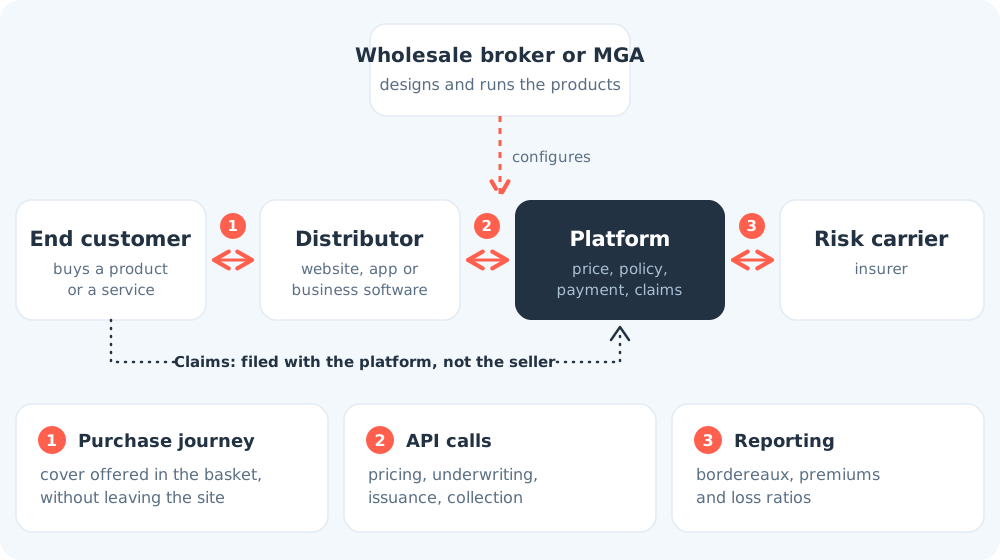
There is the risk carrier; an intermediary that designs and runs the products (a wholesale broker or an MGA); the third-party distributor, the partner selling its product or service; and the end customer. Each brings its own expertise, and the digital platform ties them together by centralising policy administration.
A policy’s journey, from click to certificate
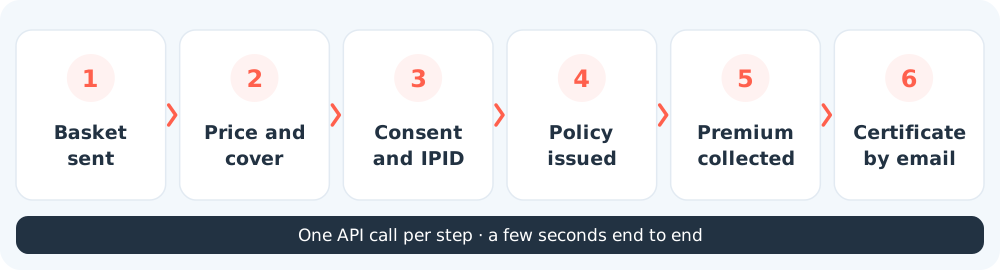
An embedded sale usually follows six steps, each one matching a technical call:
- The distributor sends the basket or booking details.
- The rating engine returns a price and the available cover.
- The customer accepts and receives the standardised information document.
- The policy is created and its issuance triggered.
- The premium is collected, often together with the main purchase.
- The certificate and the terms and conditions go out by email.
What data to send for pricing
The distributor sends only what is strictly necessary. A few well-chosen fields are enough for an accurate price: value of the item, dates, country, age. Keeping that number low improves conversion, and it is also what the GDPR requires under data minimisation.
Issuance and payment: what can be automated
Policy issuance, document generation and payment can be fully automated, with processes configured once and for all. Billing and the split of commissions are harder to handle, especially when several intermediaries are involved.
What happens when there is a claim?
Customers file their claim with the administrator, not the seller. The platform has to link each claim to the right policy and the right channel, for fast handling and reliable reporting. A solution such as Korint Claims follows the claim from first notice to settlement.
Synchronous or event-driven: two possible architectures
In synchronous mode, each step waits for the previous one to answer: simple and quick to set up, but fragile if a service slows down. In event-driven mode, systems publish and listen to events (“policy issued”, “premium received”), an architecture that is more resilient and more flexible. Recent platforms generally combine the two.
Examples of embedded insurance by sector
Use cases multiply as soon as a purchase creates a risk customers want to cover on the spot.
Travel and ticketing
Cancellation, luggage, assistance: for travel, protection is offered at the time of booking. It is the historic home of embedded solutions, and the one where the customer experience plays out on a single page.
Mobility and rental
For a rental, ride-hailing or micromobility business, cover is switched on for a set period, sometimes by the day. The Yeet case, a specialist in insurance for ride-hailing drivers, shows the value of automated weekly payments.
E-commerce and product protection
Breakage, theft, extended warranty: protection is added to the basket like an accessory. How readable the cover is directly drives the attach rate of these insurance products.
School insurance for pupils
School and after-school enrolment platforms can offer cover to pupils’ families at enrolment, with a single price and quick sign-up.
Multi-country offers and insurance at global scale
A brand present in several countries often wants to connect all of them through a single integration. That means handling languages, currencies, taxes and local rules. Infrastructure hosted in Europe can perfectly well serve as the foundation for insurance at global scale, provided those parameters are planned for from the design stage.
What rules govern embedded insurance?
Selling in two clicks does not waive any regulatory obligation. The Insurance Distribution Directive (IDD) applies to the whole chain, from manufacturer to seller.
Does the distributor need to be registered with ORIAS?
In principle, yes: in France the seller acts as an ancillary intermediary and registers with ORIAS. Under certain conditions, the IDD provides an exemption when the premium does not exceed €600 a year, or €200 per person for a service lasting three months or less. The registered intermediary then remains responsible.
Duty to advise: who is responsible in 2 clicks?
The duty to advise sits with the distributor, but the manufacturer has to give it the means to meet it. The journey must check the customer’s demands and needs, hand over the standardised information document (IPID), whose content is set at European level, and keep proof of every step.
Product governance and target market
The IDD and its delegated regulation on product oversight and governance require defining a target market, testing products and monitoring them over time, consistently with the risk carrier’s underwriting policy.
The French supervisor, the ACPR, spelled out these expectations in its recommendation 2023-R-01, in force since 1 January 2024.
What the CCSF changed for affinity insurance
In its opinion of 17 January 2023, France’s financial-sector advisory committee (CCSF) extended the cooling-off period for affinity insurance from 14 to 30 days, with a welcome letter and an annual statement. These rules have applied since 1 January 2024.
GDPR, DORA, AI Act: the other regulatory requirements
Three more European texts bear on your business:
- the GDPR, which governs consent and the confidentiality of customer data, supervised in France by the CNIL;
- the DORA regulation, in force since 17 January 2025, which requires digital operational resilience and oversight of third-party providers;
- the AI Act, which classifies AI-based pricing in life and health insurance as high-risk.
Benefits and limits for brokers and insurers
The model is attractive, but its profitability depends on a clear strategy and well-controlled execution.
New distribution channels and revenue streams
Every connected business becomes a digital point of sale with no physical network cost. For a wholesale broker, it is a way to multiply channels, open new revenue streams and accelerate growth.
A better customer experience
Customers have no form to fill in and no meeting to book: they are covered the moment they buy. That smoothness lifts take-up and satisfaction, provided after-sales administration keeps up.
The costs that are often underestimated
Budgets rarely overrun on technology alone. They overrun on the processes around it:
- integration at each distributor, which ties up its own developers;
- support for sellers whose core business is not insurance;
- regulatory and financial reporting by channel;
- migrating existing policies during a switchover.
Key features of an embedded insurance platform
A good platform covers the full lifecycle of the insurance policy without multiplying tools. These are the features to check first.
Configure a product without code
Cover, excesses, questionnaires, document content: the business team must be able to change all of it without going through developers. That is what makes it possible to launch new products quickly and stay flexible.
A pricing and underwriting API
The rating engine has to answer in real time and reliably, with a documented API for the distributor’s developers. The Korint documentation and the Engine rating engine, built for this kind of use, show that standard.
Compliance recorded automatically
Every policy must keep a record of the documents handed over, the consents given and the AML/CFT checks. By automating that evidence, the platform secures regulatory compliance and reduces risk during an audit.
Managing distributors and commissions
The same products can be sold by dozens of introducers, each with its own commission rate and per-user permissions. The platform must manage these rules centrally, which simplifies month-end operations.
Real-time data and reporting
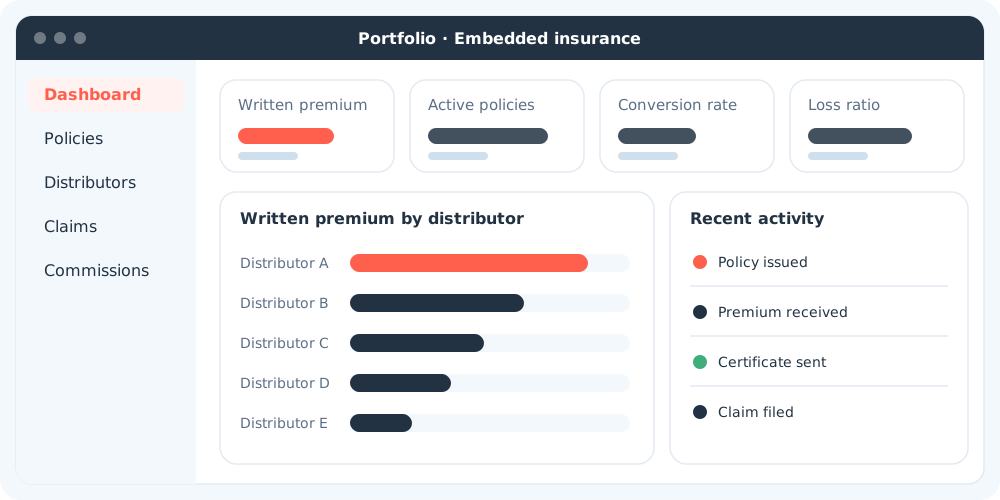
Conversion rate, written premium, loss ratio by channel: these indicators guide commercial decisions and measure the impact of each channel. Here is the checklist of essentials:
- product configuration without development;
- automated pricing and issuance;
- built-in payment collection (direct debit, card, instalments);
- claims management;
- dashboards by distributor;
- an audit trail of checks;
- native connectors to market tools.
How to choose embedded insurance software
Choosing a solution commits your business for several years. It is best done with a clear scorecard, shared between the head of distribution and the technical team.
The 8 selection criteria
- Time to put a first product into production.
- How independently business teams can change processes.
- Quality of the technical documentation and the user interface.
- Functional coverage, from pricing to claims.
- Security certifications (ISO 27001, SOC 2).
- Where the data is hosted.
- Number of native integrations.
- Ability to keep up with your growth in volume and countries.
Build in-house, adapt a core system or choose a modular platform
Three families of solutions exist for businesses in the industry. The table below compares them, in indicative orders of magnitude.
| Criterion | In-house build | Legacy core system | Modular platform |
|---|---|---|---|
| Time to launch | 12 to 24 months | 6 to 18 months | A few weeks to 3 months |
| Upfront cost | High | High | Moderate |
| Product flexibility | Total, bespoke but costly | Low | High, without development |
| Compliance | To be built | Often rigid | Native |
| Connections to tools | Case by case | Limited | Ready-made connectors |
| Scaling | Depends on the team | Heavy | Built for scale |
Questions to ask a vendor
- How long did your last launch take?
- Can my teams change their products on their own?
- Where is the data hosted?
- How do you handle migrating an existing portfolio?
- Which security certifications do you hold?
Common mistakes at launch
- Designing products for the risk carrier rather than for the distributor’s experience.
- Underestimating the integration effort on the distributor’s side.
- Treating compliance at the end of the project.
- Starting without tracking indicators by channel.
Korint, an embedded insurance platform for brokers, MGAs and insurers
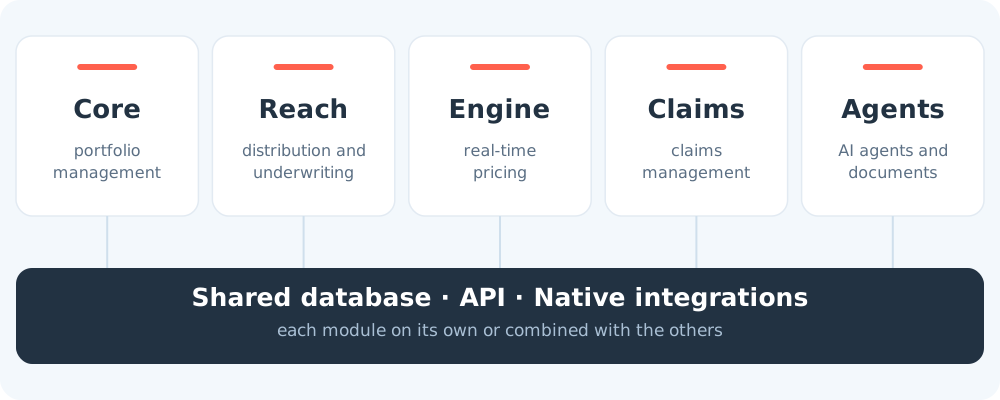
Korint is a modular digital platform built for insurers, MGAs, delegated-authority brokers and wholesale brokers. Through its modular architecture, it brings policy administration, distribution, pricing, claims and AI agents together in one environment, without multiplying systems or manual processes in your operations.
A modular, open architecture
Each module can be deployed on its own or combined with the others:
- Core: online portfolio management;
- Reach: run direct, broker or affinity distribution with a polished experience;
- Engine: a rating engine that answers in real time;
- Claims: claims management;
- Agents: document automation and AI agents.
Native integrations, from Salesforce to Stripe, let you plug in the services your teams already use. Browse them on the marketplace.
Security, compliance and European hosting
Korint runs a security policy certified ISO 27001 and SOC 2 Type II, GDPR-compliant, with hosting in Europe. Being secure and European-hosted does not prevent deployment outside Europe: the platform also supports multi-country programmes and international partners.
Real customer cases: WTW, Yeet, Tutassur
WTW launched an online car-assistance offer in 10 weeks for the employees of a major car manufacturer, while lightening its internal operations. Yeet migrated its portfolio in under 3 months, integrating its existing tools, then grew it by 15% the following quarter.
Tutassur, an MGA working with more than 200 partner brokers, runs 48 products on the platform.
Key takeaways
- Embedded insurance is a digital distribution channel in its own right.
- Its technical flows need to be understood before choosing a tool.
- The IDD, the GDPR and DORA apply to the whole chain.
- The hidden costs sit in integration and support.
- Automate issuance and checks from day one.
- A modular platform cuts time to launch to a few weeks.
Explore our white papers and our news to go further.